How to Train the Littlest Dragon
He may be barely able to reach the keyboard but this diminutive chap still put our Dragon 32 in its place!


The Archive of Retro Computing at Kingston University is dedicated to preserving and showcasing the computers and games consoles of the past, and telling the stories of the people behind them.
After last year's success, ARC@KU is throwing open the doors to the public once again. This time we've raided the archive for even more of the machines that started it all! From Wednesday 5th to Tuesday 11th August, Kingston University's Town House will once again come alive with the bleeps, bops and bloops of the classic era of home computing and gaming - and everyone's invited!
This is a small visual showcase of some of ARC@KU's activities including pop-up sessions for outreach at schools, open days at KU and our previous public-facing exhibitions.
He may be barely able to reach the keyboard but this diminutive chap still put our Dragon 32 in its place!

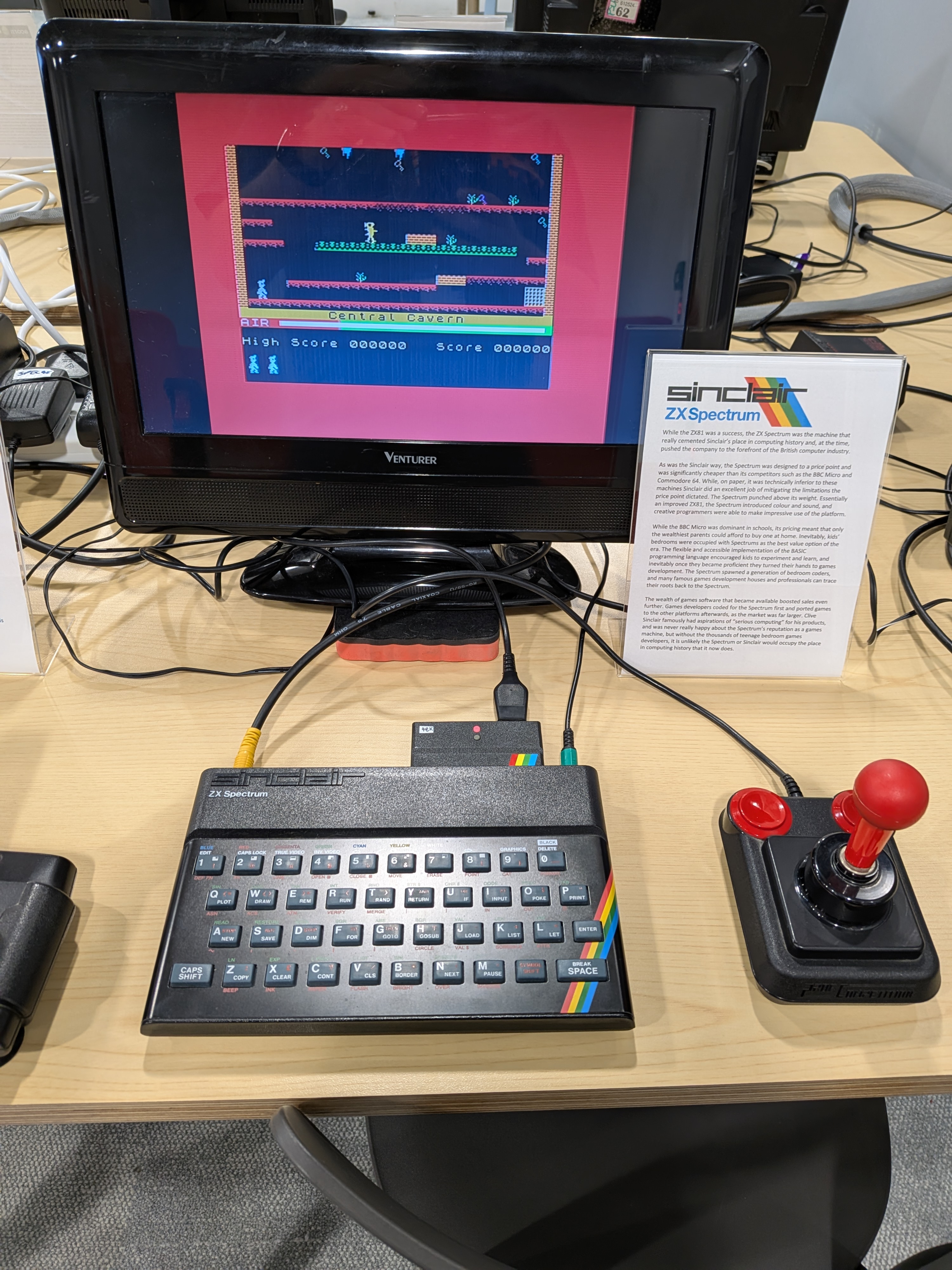
The computer is five times their age and so is the game, but for these two young exhibition visitors, Matthew Smith's Manic Miner on the Spectrum is just as addictive today as it was in 1985!

The 2025 event saw around two thousand visitors over the course of the week, drawing in people from all ages.

One of our favourite events is when students try their hands at programming - old school! One of our pedaogic themes at KU is thinking like a programmer and working with vintage languages like BASIC often gives them new insight into this mindset and process which they bring to their work with modern languages.

The wisdom of your elders is always worth listening to - especially when you're playing Golden Axe for the first time!

One of the things that always amazes me is how the youngsters take to coding on the vintage machines...!

Putting our best retro feet forward to make a KU open day memorable!

An open day visitor gets their coding hands dirty on an Atari 800.

The little known Q1 was the first true microcomputer, with its first model released in 1972. Q1 Corporation sold very few machines and mainly to governments and organisations like NASA. Here we see a Q1 Lite and Microlite loaned to us by Just Clear at last year's Creating the Everything Device event.

This pair were repeat visitors to ARC@KU 2025 - they couldn't leave until they'd cracked R-Type level 3!

The retro hordes ready for an outreach session with a local school, where the kids get to try their hand at retro-programming. And, who knows, maybe the odd game might sneak on the screens too!

And it's not all hard work and coding! Our visitors get to play the classic games, like Sonic, on the original hardware.

Or if you're a Nintendo fan instead of Sega, you could always do what this open day visitor did, and play Super Mario from start to finish! Perhaps if he does enrol at KU, maybe we should consider this achievement as contributing to course credit :)

Who needs sports games real-world physics and graphics that are barely distinguishable from reality, when you've got the original sports game, Pong? Still a big draw at every event we ever do!

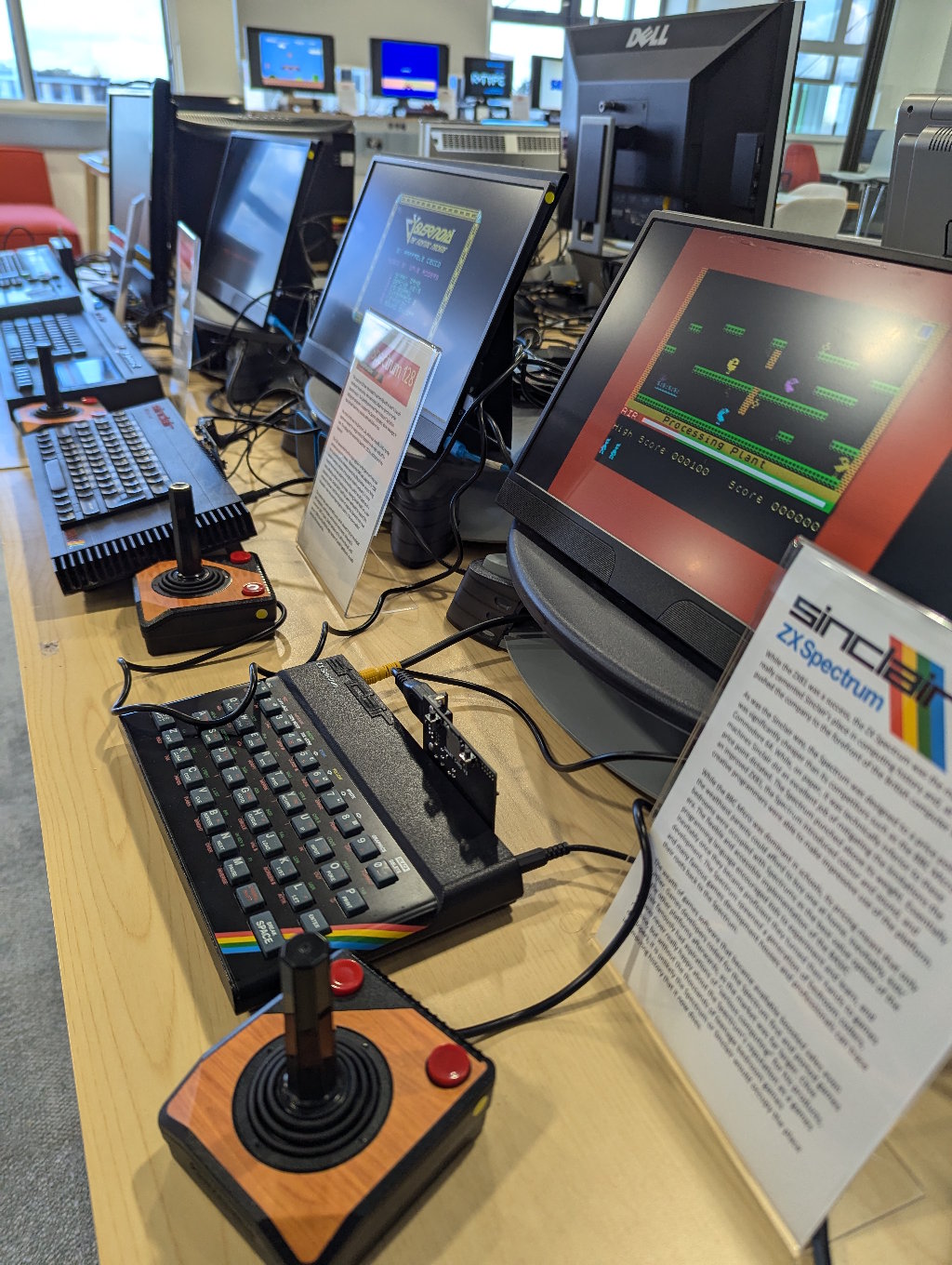
Clive Sinclair's finest - the original Sinclair Spectrum and its siblings - always go over well with parents and prospective students alike at KU open days!

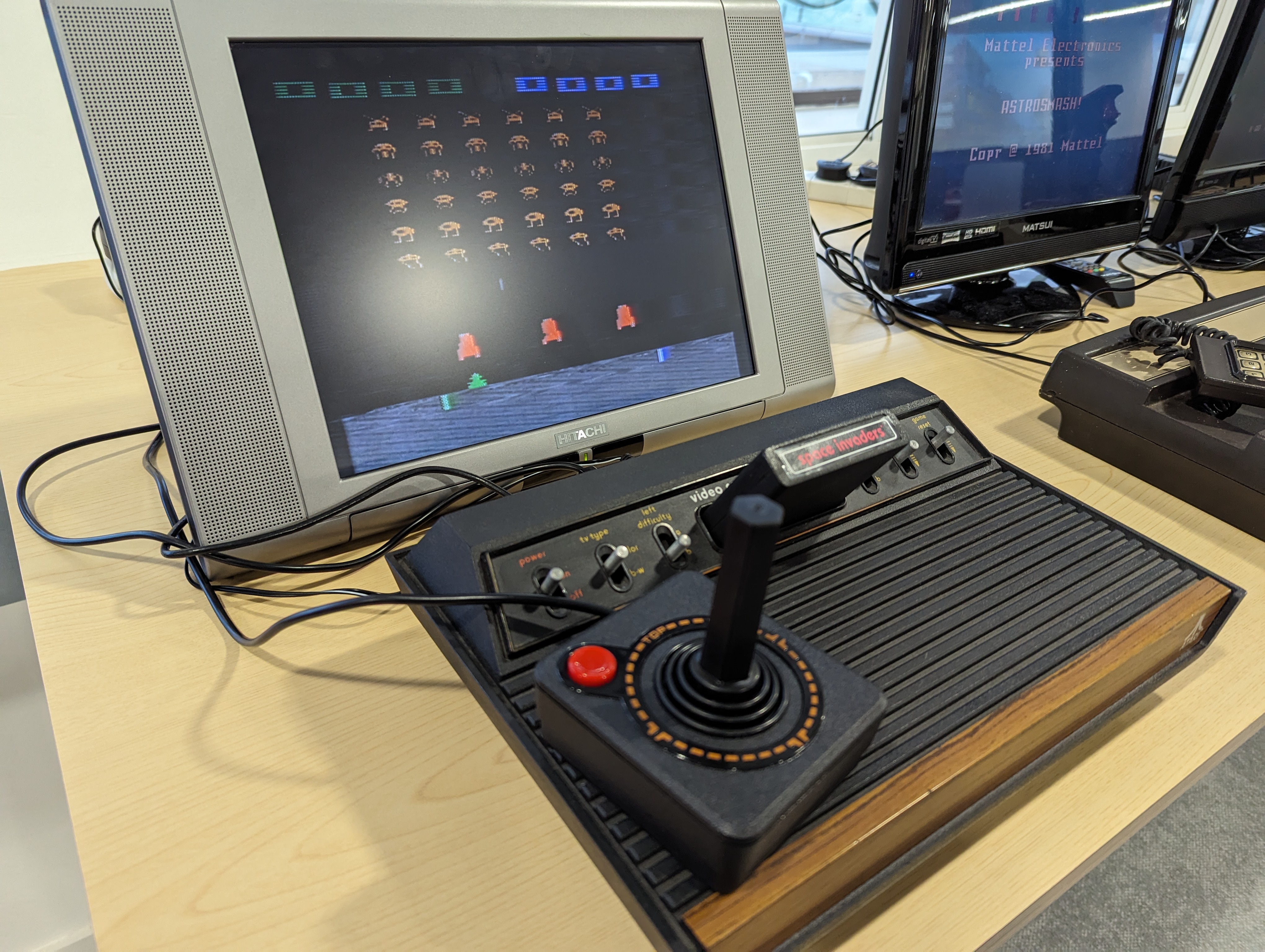
And in the interests of impartiality, naturally we have to have the 6502 CPU represented at open days too, courtesy of a BBC, an Atari and an Apple IIe. The 6502 inspired Sophie Wilson and her colleagues at Acorn when they designed the ARM processor - and today, ARM powers pretty much every mobile device there is.

One of our retro hackthon students tries his hand at BBC BASIC. The BBC Micro was the pre-eminent machine for education throughout the early 80s, and virtually every British school had one.

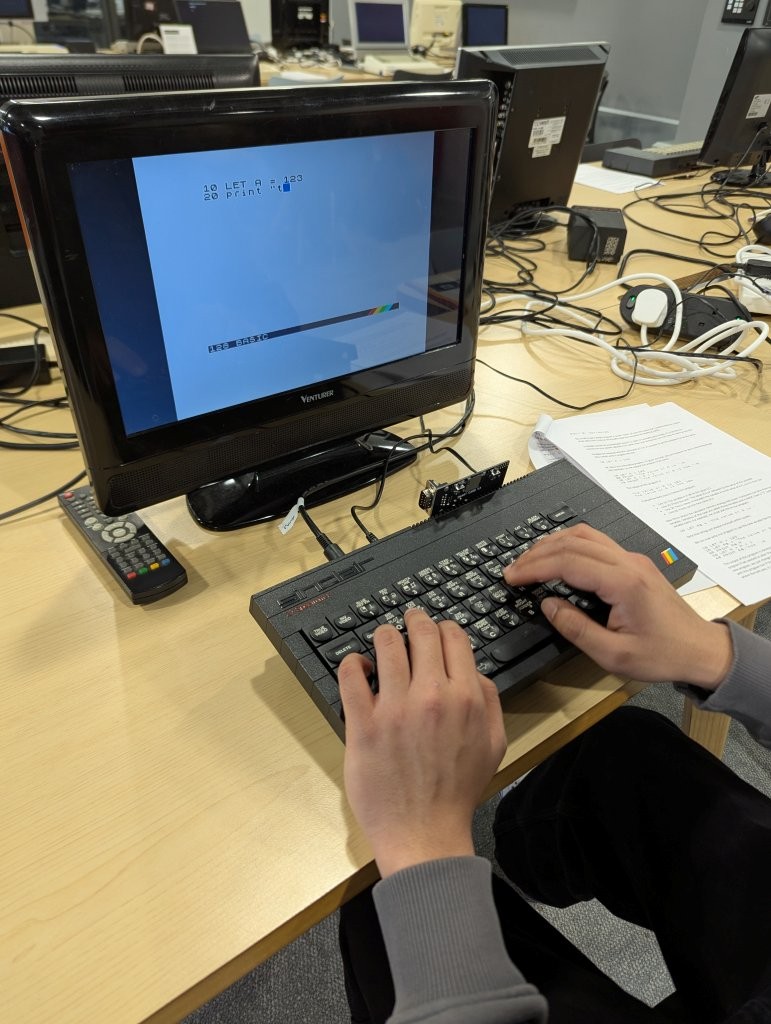
KU students from our BSc Computer Science and Computer Science and AI courses try out Sinclair BASIC on a Spectrum +3 at last year's exhibition. Perhaps they'll get a Large Language Model running on it... :)

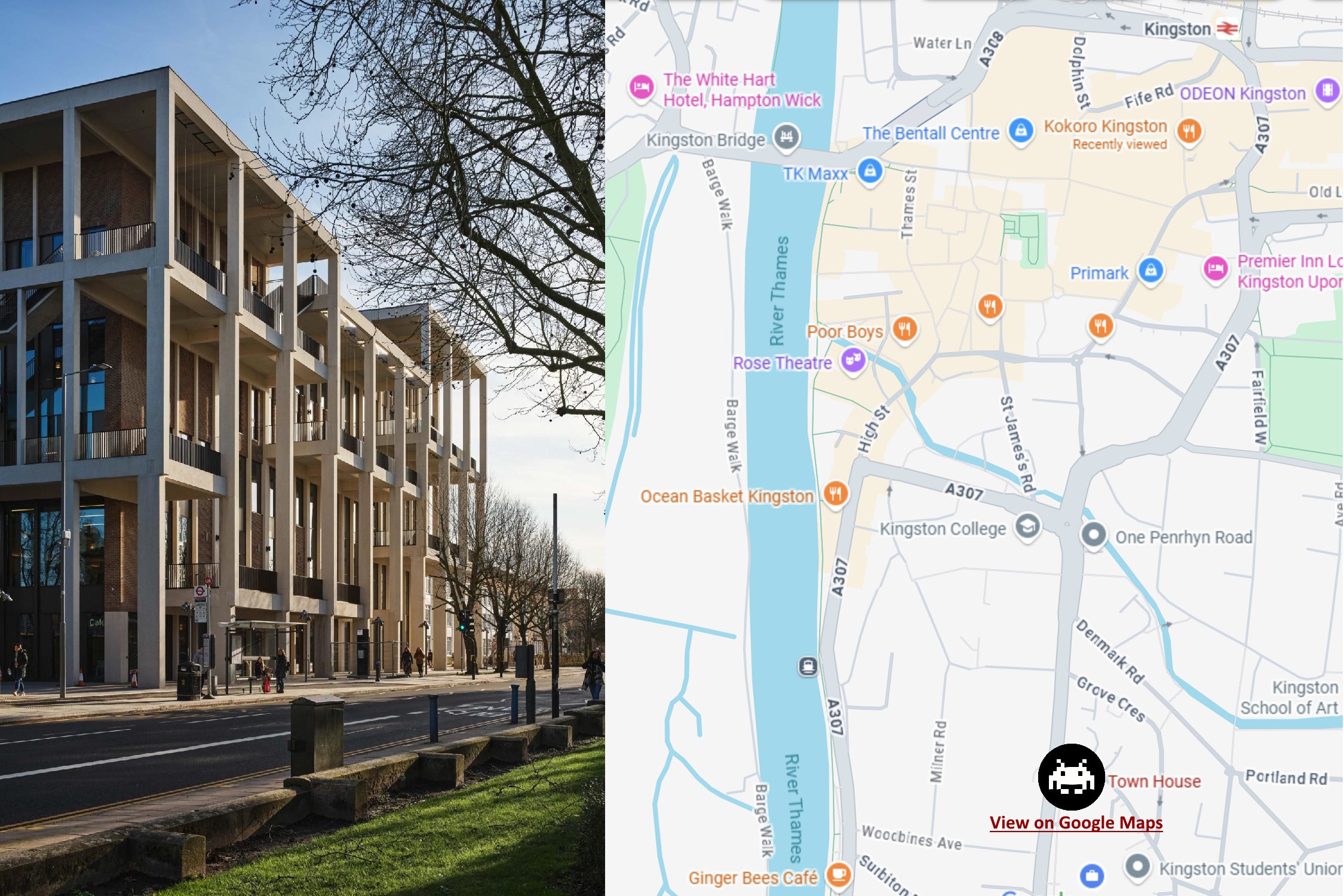
KU's iconic Town House building was the setting for our 2025 exhibition. Winner of the EU Prize for Contemporary Architecture and the RIBA Sterling Prize for the UK's best new building in 2021, it provides a state-of-the art facility for learning and teaching - and for retrocomputing exhibitions!
Our collection spans the late 70s through to the mid-90s. We focus on the home micros that really made the computer personal and took them out of the laboratories and into people's homes. In terms of games consoles, we start with the dawn of home gaming and go up to the dawn of the 3D era.

Do you have any idea how many people owe their childhood to a man they’ve never heard of? The Fairchild…

Released in 1977, the Atari 2600 is the machine that dragged video games out of the arcade and into the…

Before Commodore became famous for the Vic-20 and Commodore 64, it was primarily a manufacturer of…

Before cartridges, before microprocessors, before anything we'd recognise as a games console, there was Pong…

The original Magnavox Odyssey was the first commercial video game console, released in 1972. Internally, it…

The MPU-1000 was one face of a console that wore many. The hardware itself was designed by Radofin, a Hong…

The Atari 400 was the friendly, affordable face of Atari's first home-computer range, launched in 1979. Aimed…

If the 400 was the entry ticket, the Atari 800 was the full experience: the flagship of Atari's 8-bit line…

Before there was Xbox v PlayStation, even before there was Sega v Nintendo, there was Intellivision v Atari…

Texas Instruments was a chip-making giant, so when it moved into the home with the 99/4 in 1979 and the…

Acorn had little interest in home computing, building machines for labs and engineers, and had no plans to…

The Vic-20 followed Commodore’s first personal computer, the PET, and was the first computer of any kind to…

Science of Cambridge had been set up by Clive Sinclair as a “lifeboat” when his previous company…

In the early 80s, the British government started the Computer Literacy Project, intended to introduce…

If the ZX80 cracked the door open for British home computing, the ZX81 of 1981 kicked it off its hinges…

Born in Cambridge at the height of Britain’s home-computer boom, the Camputers Lynx was a bold…

The president of Coleco – originally the Connecticut Leather Company! – had long aspired to create a…

The Commodore 64 is, by most counts, the best-selling single computer model in history. Launched in 1982 at a…

The Commodore MAX is, in many respects, the proto-Commodore 64. The original vision for had been to create…

The Dragon 32, though not as well-known as some of its contemporaries, played a modest yet notable role in…

Do you have room in your life to adopt an orphaned 80s microcomputer? The NewBrain is perhaps the most…

Sord was a small Japanese company with big aspirations, but while their M5 was a solid machine, it failed to…

The Vectrex, released in 1982, was like nothing before it and nothing since. Instead of plugging into your…

The ZX80 opened the door for British home computing. The ZX81 blew the door off its hinges. The Spectrum…

The Acorn Electron was the BBC Micro for the rest of us: a cost-reduced version launched in 1983 to take on…

The Apple II was the first production computer from Apple. As a kit, the Apple 1 was very much something for…

By 1983 Atari's 8-bit range needed a fresh face, and the 800XL provided it: a sleeker, more modern case at a…

Computing history, especially during the 80s, is full of sad tales of ambitious, advanced computers (for the…

Memotech had made its name selling well-regarded add-ons for the Sinclair ZX81 before deciding to build a…

The Family Computer, universally known as the Famicom, was the Japanese original that would later conquer the…

The Oric-1 was a plucky British challenger to the all-conquering Sinclair Spectrum. Launched in 1983, it…

MS-DOS was not the only standard that Microsoft attempted to impose on the computer industry in the early…

The Timex Sinclair 2068 was an American reimagining of the ZX Spectrum, built by Timex, who had been…

Amstrad arrived in the computer market in 1984 with a shrewd, customer-friendly insight: sell people…

The Commodore 16, launched in 1984, was an attempt to build a budget machine to slot in below the mighty C64…

The Plus/4, launched in 1984, was Commodore's pitch to the "serious" home user. Its headline feature was a…

The Commodore SX-64 was the first ever colour portable computer, although “portable” in this context…

The Oric Atmos was a 1984 makeover of the Oric-1, and it tackled its predecessor's single biggest weakness…

The QL, short for Quantum Leap, was Sinclair's bold attempt to vault beyond games and into serious computing…

The Tatung Einstein was a British-built machine launched in 1984 with its sights set a little higher than the…

By 1984 the original Spectrum's rubbery keyboard, for all its charm, was starting to feel its age. The…

The CPC6128 of 1985 moved Amstrad's all-in-one family upmarket. It paired a generous 128K of memory with a…

The Atari ST line brought 16-bit power into the home from 1985, built around a fast, capable processor and a…

The Atari 65XE, launched in 1985, gave the long-running 8-bit range a fashionable new look, restyled to echo…

The Commodore 128 of 1985 was an unusually ambitious follow-up to the C64, and a rare example of three…

The Amiga was a machine years ahead of its time. Arriving in 1985 with the high-end A1000, it stunned…

The Enterprise was one of British computing's great might-have-beens. Announced back in 1983 with genuinely…

After the 1983 crash left Western retailers deeply wary of video games, the NES, the international version of…

The ZX Spectrum 128 gave Sinclair's best-seller a serious upgrade, and finally fixed its most-mocked…

By the mid-1980s the Atari 2600 was a veteran many times over, yet it stubbornly refused to retire. The 2600…

The Atari 7800 was built to win back the console crown from a resurgent Nintendo. It offered markedly sharper…

The BBC Master of 1986 was the natural next step for the classic BBC Micro: more memory, more built-in…

The Commodore 64C of 1986 wasn't a new computer at all; it was a sharp new suit for an old champion. It…

While Nintendo's NES ruled Japan and North America, the story in Britain, much of Europe and famously Brazil…

When Amstrad bought Sinclair's computer business, the ZX Spectrum +2 of 1986 was the first new machine to…

The Acorn Archimedes of 1987 was a genuinely historic machine: the first home computer built around the ARM…

The Atari XEGS, launched for Christmas 1987, was an inventive piece of repackaging: an Atari 8-bit computer…

The PC Engine, launched in Japan in 1987, was a little marvel: a tiny console that punched far above its…

The ZX Spectrum +2A of 1987 was a subtle but telling reshuffle of Amstrad's Spectrum range. It shared its…

The ZX Spectrum +3 of 1987 was the final and most advanced model in the long Spectrum story, and the only one…

The Sega Mega Drive brought true 16-bit, arcade-quality gaming into the home from 1988, powered by the same…

The SAM Coupé was a British attempt to build a "super Spectrum": a more powerful machine, from the small…

The CPC6128+ was the flagship of Amstrad's "Plus" range, a 1990 revamp of the much-loved CPC line. It added…

The GX4000 was Amstrad's attempt to crash the console party in 1990. Built from the bones of its CPC Plus…

If you wanted proof that video games could be a serious luxury business, look no further than the Neo Geo…

Released in Japan in 1990 as the Super Famicom, the SNES was Nintendo's 16-bit masterpiece. Its custom…

The Atari Jaguar of 1993 launched with a bold and much-trumpeted claim: that it was the world's first 64-bit…

Poor old Sega Saturn. In another timeline, one where Sega hadn't spectacularly mishandled its launch, this…

The original PlayStation arrived in the UK on 29 September 1995, and nothing was ever quite the same again…

When the Nintendo 64 launched in the UK on 1 March 1997 — a full 16 months after the PlayStation —…

The Sega Dreamcast was a magnificent machine launched by a company that had run out of runway. Released in…

Sony promised gamers more bang for their buck. The Japanese government took that rather more literally: the…

Imagine sitting in a boardroom while an entire company laughs at you for an hour. That, more or less, is how…
Our YouTube channel showcases what we're up to, our exhibits, and legendary people, companies and computers from history, but you'll always be able to watch our latest video below.
We love sharing these important pieces of history with other people. Whether that's taking exhibits on the road, or having people come in and get hands-on at KU - we're happy either way. Here are some of the events and activities we can do with you:
We can bring a selection of machines to your school, college, or youth club - or you can bring your classroom or group to our campus for a retro-programming and computing history session.
You can come to us or our academic can visit you for talks about this fascinating period of computing history. Of course, we wouldn't come empty handed - there'd always be the chance for a bit of hands-on afterwards!
Fancy a session of retrogaming action in your venue? We can bring the classic gaming platforms - you bring the catlike reflexes and friends.
To join our mailing list to hear news about what we're doing and upcoming events, please enter your email address below. The only emails you'll ever receive from will be about ARC@KU activities and we will not pass your address onto anyone else.
In the first instance, the primary contact for ARC@KU is Paul Neve. Get in touch with Paul by emailing paul@kingston.ac.uk. Either he or one of his colleagues will be back in touch as soon as possible.